
I’ve Looked at the Web Design Stats. Most Businesses Should Be Worried.
Most articles stuffed with web design statistics get quoted to death by agencies trying to sell websites and ignored by everyone who actually needs to read them.
Which is a shame. Because some of these numbers genuinely matter.
After 20-odd years of building websites at Bamboo Manchester, I’ve sat across the table from a lot of business owners who reckon their website is “fine.” Then we run the numbers, check the speed, look at it on a phone, and the conversation tends to shift.
So here’s an honest run through the web design statistics that actually mean something for small businesses. With my take on what each one really tells you, rather than the tidy version every agency repeats.
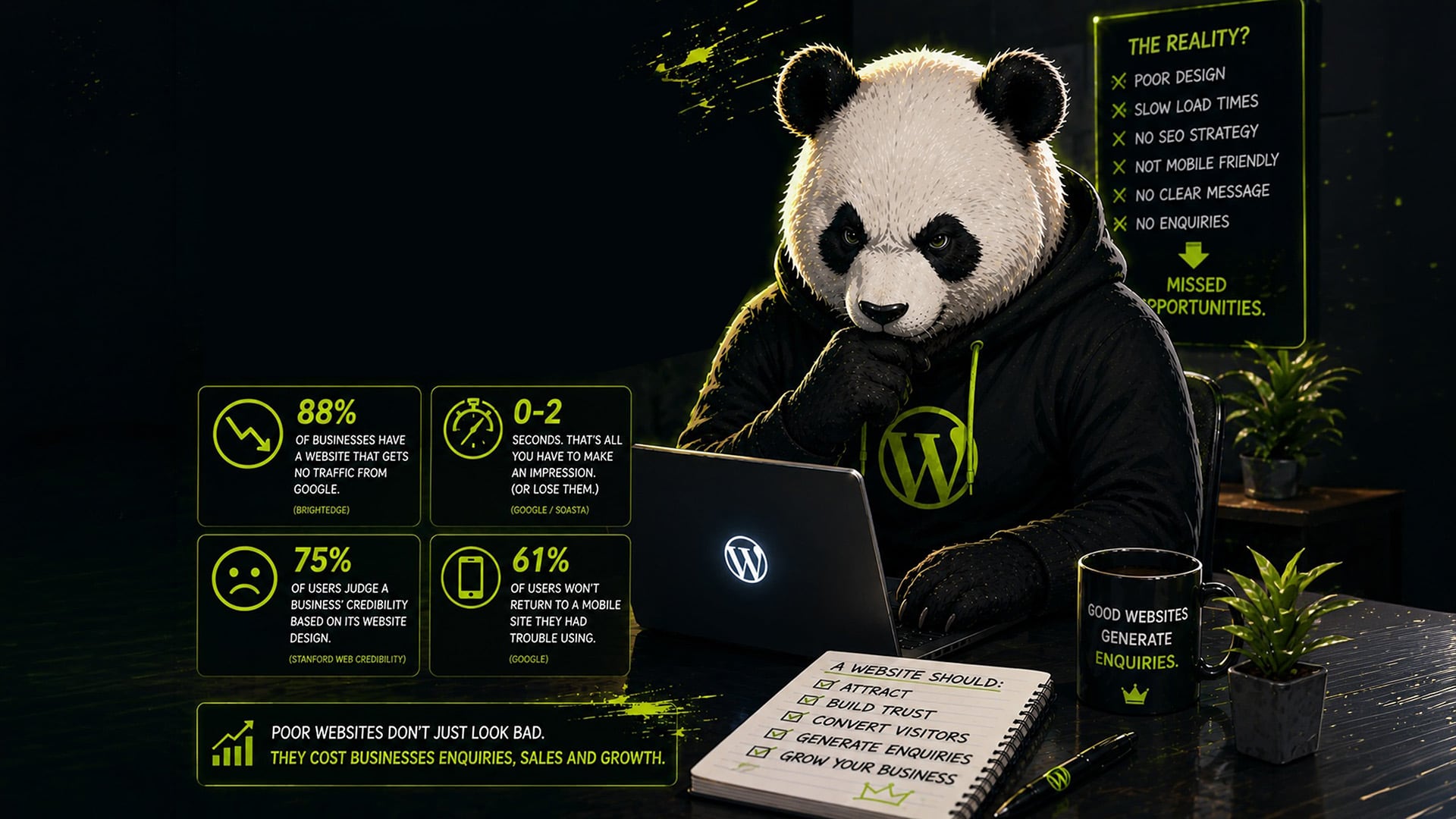
People decide whether to trust your website in around 0.05 seconds
I’ll start with the one that always gets a reaction.
Studies have consistently shown that visitors form a first impression of a website in roughly 0.05 seconds. That’s not a typo. Fifty milliseconds. Faster than a blink. Faster than they’ve read a single word of your copy.
What does that actually mean for you?
It means the design does almost all the heavy lifting before any of your carefully written content gets a look in. The colours, the layout, the photography, the way the page loads — that’s what people are reacting to first.
It’s also why around 94% of first impressions of a website are related to its design rather than its content. People aren’t reading. They’re feeling.
If your site looks ten years old, people clock it immediately. If it looks like a template anyone could buy off the shelf, they clock that too. And no, they don’t say it out loud — they just bounce and find someone else.
75% of website credibility comes down to design
This one tends to genuinely worry owners when I show it to them.
Three quarters of how trustworthy your website seems comes down to the design itself. Not your reviews. Not your awards. Not even the brilliant work you do day to day. The website.
If you’re a tradesperson, accountant, solicitor, consultant or anyone else whose business runs on trust, that should make you sit up.
I’ve seen excellent businesses with awful websites lose work to less experienced competitors with better-looking ones. It isn’t fair. But it’s how it goes.
The fix isn’t always a full rebuild, by the way. Sometimes a proper design update, better photography and tighter structure does the job. Sometimes it doesn’t and the whole thing needs starting again. Honest answer: it depends what you’ve got.
Mobile isn’t “also important” any more. It’s the main thing.
Globally, around 65% of website traffic now comes from a phone. For some of our clients in retail and consumer services, it’s closer to 80%.
A lot of websites are still designed desktop-first and then squashed onto a phone with a few media queries doing the bare minimum. You can usually spot one within a few seconds. The menu’s clunky. The buttons are too small. Images load late or not at all. Something’s overlapping that shouldn’t be.
Around 72% of people now expect a business to have a properly mobile-friendly site. They don’t ask. They assume. When yours doesn’t work on a phone, you’ve already lost them.
It’s also why we build every WordPress site we deliver to be properly mobile-first, not desktop-first with mobile bolted on.
Three seconds.
That’s not a long time to get it wrong.
Speed and friction quietly kill conversions
This is the bit most owners underestimate.
Page speed affects willingness to buy from an online retailer by around 70%. About 42% of users will abandon a site with poor functionality. 39% stop interacting with a page if the images don’t load properly.
None of this is dramatic stuff. There’s no flashing red warning. People just leave. Quietly. The analytics show “high bounce rate” or “weak conversion” and the owner thinks the marketing isn’t working.
Often, the marketing’s fine. The website’s the problem.
The biggest offenders I see, again and again:
- Hero images that haven’t been compressed properly
- Theme builders stacking ten different scripts onto the homepage
- Hosting that’s too cheap to actually do its job
- Contact forms that ask for far more than they need to
- Checkouts that demand an account before they’ll take an order
That last one matters more than people think. Around 21% of all cart abandonment comes down to a checkout that’s too long or too complicated. Every extra step is another chance for someone to change their mind.
This is the kind of thing proper WordPress development sorts out at the build stage rather than patching later.”
89% of people will switch brands after a poor user experience
This one’s quietly brutal.
It means all the work you’ve done — the marketing spend, the social media, the networking, the referrals — can be undone by one frustrating session on your website.
89%. Nearly nine out of ten.
It gets worse. About 44% of people will tell their friends and family about a bad experience online. So you don’t just lose the sale. You lose the people they would have recommended you to.
The flip side: businesses with genuinely good user experience can see conversion rates up to 400% higher than ones without. That isn’t marketing fluff — it’s what happens when the site has been properly thought through, the journey is clean, and the friction’s been stripped out.
A well-built website isn’t a luxury. It’s the bit that decides whether the rest of your marketing pays for itself.
Reviews carry more weight than anything you write yourself
Around 92% of consumers read reviews before buying. 88% trust online reviews roughly as much as a personal recommendation from someone they know. 72% see customer reviews as the main signal of whether a brand is credible.
None of this is news. We all know reviews matter. The point is that most websites still don’t put them anywhere useful.
Testimonials buried on a hidden page nobody clicks. Google reviews not pulled into the site at all. Case studies written to make the agency look good rather than the client. I’ve redesigned a lot of those.
If you’ve got happy clients, your website should be working much harder to show it.
A quick note on the UK industry
This is where most stats articles run out of steam and start padding. But there’s one number worth knowing.
The UK has over 2.7 million active websites and roughly 2,000 web design agencies competing for the work. The market’s loud. A lot of agencies talk a similar game. A lot of finished websites end up looking similar because they were built from the same templates and the same design systems.
What this means for you: be careful who you pick.
The cheap end of the market is full of people who’ll knock something out and disappear. The expensive end is full of “Award Winning” agencies billing for things you don’t need. The good ones sit somewhere in the middle, are honest about what your project actually needs, and don’t vanish the day after the site goes live.
Bamboo’s a small team, deliberately. Fewer projects on at once, more thinking per pound. Take that as you find it.
What I’d actually do with these numbers
If you’ve read this far, you don’t need me to recap.
What I’d suggest instead: open your own website on your phone right now. Not your laptop. Your phone.
Time how long it takes to load. Try and find your most important page in three taps. See how the photos look. See if the contact form works without making you swear.
Most owners haven’t done this in months. Some haven’t done it ever. And it’s the single most useful thing you can do without paying anyone a penny.
If it feels slow, looks dated, or doesn’t quite work — that’s the data point that matters more than any of the statistics above. The numbers are useful for context. Your own site, on your own phone, is where the real answer is.
If you want a hand sorting it out, that’s what we do at Bamboo Manchester. WordPress builds, custom themes, proper SEO that delivers real results, sites that actually work on a phone, and honest advice about whether you need a full rebuild or just a tidy-up.

Written by
Simon Nolan
Creative Designer & Developer
Hi, I’m Simon, and I run Bamboo Manchester. After more than 25 years working in web design and development, I still get the same buzz from bringing an idea to life on screen. Whether it’s crafting strong visual identities, improving SEO, Using AI or building completely bespoke WordPress sites, I care about making things that work beautifully and perform brilliantly.