
Your Website’s Live. So What’s It Actually Doing for the Business?
I’ve seen a lot of businesses launch a new website, feel good about it for a few weeks, and then sort of… leave it alone.
The site goes live. Everyone has a quick look. The homepage gets shared on LinkedIn. A few people say it looks great.
Then nothing much happens.
No one checks what it’s doing. No one looks at the search terms. No one checks if the contact form is being used. No one asks whether the website is actually helping the business.
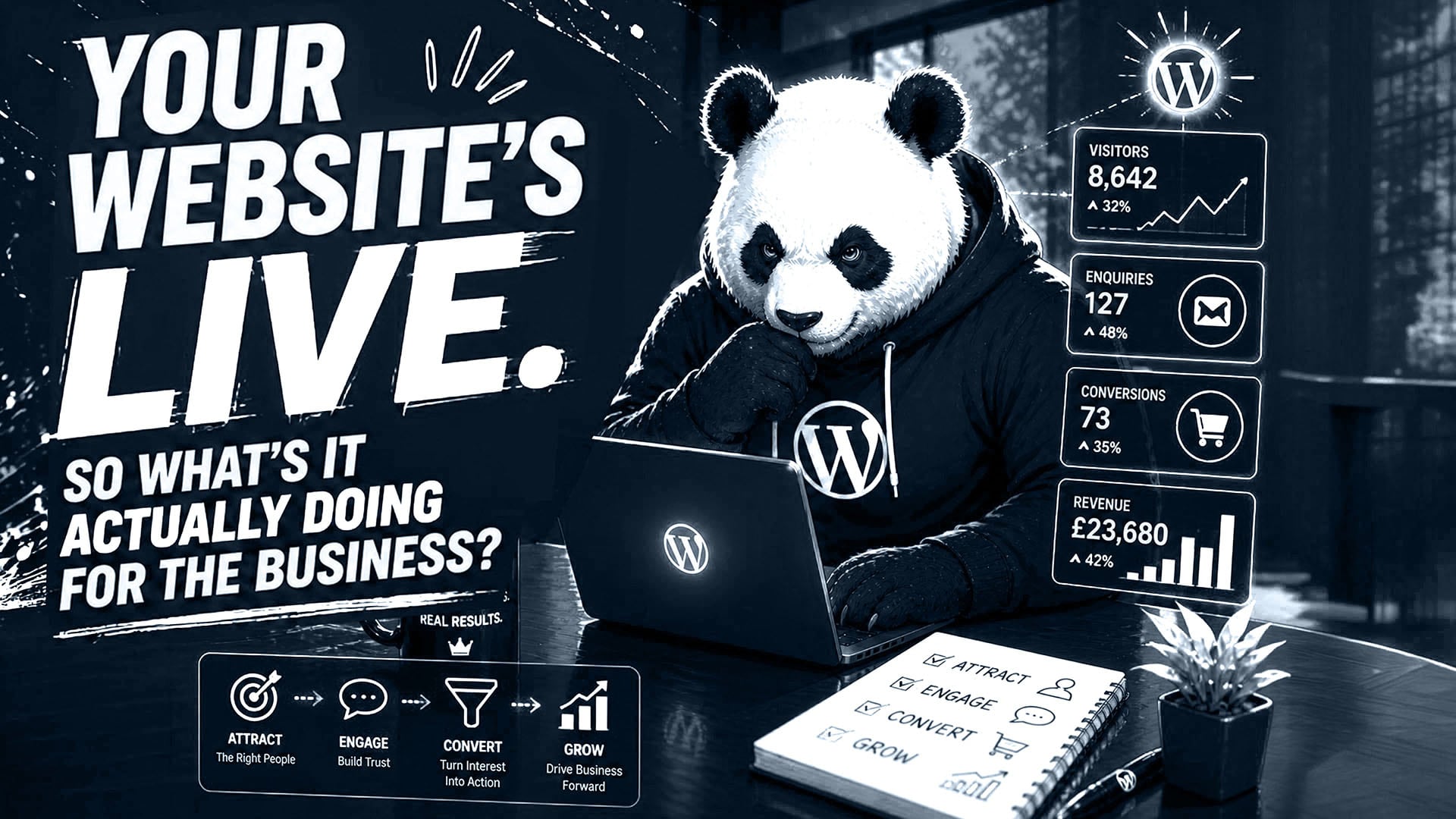
And that’s a problem, because a website shouldn’t just be live. It should be doing something useful. It should help people find you. It should build trust. It should explain what you do clearly. It should support sales conversations. It should help generate enquiries.
If it isn’t doing any of that, it might look finished, but it isn’t really working.
Looking good is only the start
I’m a designer so I obviously think web design matters. But I know design on its own won’t carry a website very far if the thinking underneath is weak.
I’ve seen websites that look polished but don’t explain the business properly. I’ve seen lovely homepages with no clear call to action. I’ve seen expensive websites that Google can barely understand. I’ve seen sites where the best service the company offers is hidden three clicks deep behind a vague menu label.
A website needs to look good, yes. But it also needs to work hard behind the scenes. It needs structure. It needs clear content. It needs proper SEO foundations. It needs to load quickly. It needs to work on mobile. It needs to make the next step obvious.
Otherwise, it’s just a nice-looking brochure floating around online.
Start with the obvious question
What is the website meant to do?
That sounds simple, but it’s where a lot of website projects get a bit vague. For some businesses, the website needs to generate quote requests. For others, it needs phone calls, bookings, online orders, applications, downloads or people filling in a creative brief.
The goal matters because it changes how you measure success.
If the website is meant to generate enquiries, then enquiries are the thing to track. Not just traffic or how many people liked the launch post but actual enquiries and good ones (ideally).
A website with 10,000 visitors and no leads isn’t doing its job. A website with 600 visitors and five strong enquiries might be doing really well.
It depends what the business needs.
Are the right people finding it?
Website traffic can be misleading. It’s nice to see traffic going up, but more visitors don’t always mean better results. You need to know whether the right people are finding the website.
Are they searching for the services you want to sell? Are they landing on useful pages? Are they in the right location? Are they the type of customer you actually want? This is where SEO becomes really important.
Google Search Console can show what people searched before they found your site. It can show impressions, clicks, average positions and which pages are appearing in search.
That information is super valuable! If your website is appearing for irrelevant searches, the content may need tightening. If it’s getting impressions but no clicks, the page title or meta description might not be strong enough. If the right pages aren’t appearing at all, the site may need better structure.
It’s rarely one magic fix ->It’s usually a set of small, sensible improvements.
This is the big one.
Are people contacting you? If the website is meant to bring in enquiries, you need to know whether people are actually contacting you.
That could mean:
- contact form submissions
- phone calls
- email clicks
- quote requests
- bookings
- e-commerce orders
- creative brief submissions
The method depends on the business but the point is the same. You need to know whether the website is turning visitors into action.
A lot of businesses don’t track this properly. They just have a feeling that “the website doesn’t do much” or “we get the odd enquiry”. That’s not enough really.
You don’t need a ridiculous dashboard with fifty reports. But you do need some basic visibility. If people are visiting the website but not contacting you, something needs looking at.
Maybe the call to action is weak. Maybe the content doesn’t answer enough questions. Maybe the form is too long. Maybe the phone number is hard to find on mobile. Maybe the page is attracting the wrong visitors.
There’s always a reason.
Are the important pages doing their job?
Not all pages carry the same weight for example, your homepage matters. But your service pages often matter more.
If someone lands on a page about WordPress websites, SEO, e-commerce or website support, that page has a job to do. It needs to explain the service clearly, build confidence and move the visitor towards an enquiry.
A weak service page can quietly cost you work.
It might be too thin. It might sound too generic. It might fail to answer obvious questions. It might not show enough proof. It might not link to related case studies or useful articles.
This is why I like looking at pages individually.
- Which pages get traffic?
- Which pages rank?
- Which pages generate enquiries?
- Which pages should be important but aren’t doing much?
- That last one is often where the opportunity is.
Is the website helping people trust you?
Trust is harder to measure, but it’s still important.
Your website should make the business feel credible and that doesn’t mean it has to be flashy. In fact, for a lot of businesses, flashy can work against them. Trust usually comes from clarity.
Clear services. Real examples. Good design. Useful content. Testimonials. Case studies. Team details. Easy contact options. A site that feels current and cared for.
If a website looks abandoned, people notice.
Old news posts. Broken layouts. Slow pages. Poor mobile design. Out-of-date team profiles. Missing security. Forms that don’t work.
These things chip away at trust and sometimes the visitor won’t tell you. They’ll just leave and choose someone else. That sounds a bit dramatic, but I’ve seen it happen.
Is the website easy to use on mobile?
Most people will see your website on a phone at some point. So the mobile version can’t be an afterthought.
Check it properly. Not just in a browser preview. Use an actual phone.
Can you read the text easily? Can you tap the buttons? Is the menu obvious? Is the phone number easy to find? Does the form feel simple? Do pages load quickly? Does anything overlap, jump around or feel cramped?
A website can look brilliant on a big desktop screen and still be awkward on mobile. If your mobile version is poor, you’ll lose enquiries. Quietly.
Speed matters
Is the website fast enough? People won’t wait around. I don’t. You probably don’t either. If a website feels slow, clunky or unstable, visitors start losing confidence before they’ve even read the page.
Slow websites can be caused by oversized images, poor hosting, too many plugins, heavy themes, tracking scripts, badly loaded fonts or messy code.
Sometimes it’s one big issue. Usually it’s a few smaller ones stacked together and this is where building and developing websites properly really matters.
A website should feel quick, stable and clean. It shouldn’t feel like it’s fighting itself every time a page loads.
Is it improving over time?
This is the bit I care about more and more. A website shouldn’t stand still.
Once it’s live, the work doesn’t stop. The website should improve as the business grows.
New service pages. Better case studies. Useful articles. Stronger internal links. Updated FAQs. Improved page titles. Faster loading. Better calls to action. Fresh images. More helpful content.
Small improvements add up. This is especially true for SEO.
Competitors don’t stand still. Google changes. Search behaviour changes. Your services change. Customers ask new questions.
If your website hasn’t changed in two years, there’s a good chance it’s falling behind. Not always visibly. But underneath, it probably is.
What should you actually measure?
You don’t need to track everything. In fact, tracking too much can make things worse because no one knows what matters.
For most small business websites, I’d look at:
- enquiries
- quality of enquiries
- organic search traffic
- search terms in Google Search Console
- rankings for important services
- contact form submissions
- phone call clicks
- key page performance
- mobile usability
- page speed
- conversion rate
- which pages users visit before contacting you
That’s enough to start making better decisions! The aim isn’t to create a perfect report. The aim is to understand whether the website is helping the business.
The website should earn its keep!
A website is a business asset. It should support your sales, your marketing, your reputation and your growth. It should make it easier for the right people to find you and easier for them to trust you.
This doesn’t happen by accident. It comes from proper planning, good design, clear content, strong SEO and ongoing improvement.
That’s how we look at websites at Bamboo Manchester.
Not just as something to launch. Something to build properly, look after and keep improving.
Small team, proper results.

Written by
Simon Nolan
Creative Designer & Developer
Hi, I’m Simon, and I run Bamboo Manchester. After more than 25 years working in web design and development, I still get the same buzz from bringing an idea to life on screen. Whether it’s crafting strong visual identities, improving SEO, Using AI or building completely bespoke WordPress sites, I care about making things that work beautifully and perform brilliantly.